
- Brady is a 110-year-old family business that makes high-performance labels that can withstand some of the harshest conditions in the world.
- Its labels have been used in the Manhattan Project, the Trans-Alaska Pipeline System, the Gemini spacecraft and SpaceX’s Falcon 9.
- Brady’s secret sauce is in-house production of all components, protected by a large portfolio of patents.
- Brady has superior profitability and return-on-capital characteristics than the wider small cap universe, yet trades at a valuation discount.
Brady Corporation, a business founded in 1914 offering sign painting, has now evolved into a leading niche label maker for harsh environments. Sounds boring? We don’t think so… we believe Brady is a hidden gem within the global small company universe, with extraordinary intellectual property and a right to win in high-end industrial markets.
Today Brady’s main products are a suite of label makers, labels, nameplates and engraving tools. Robust labelling is often required by law to identify and track key components of machinery and equipment that operate under extreme environments where safety is critical.
For example, Brady marked pipes for the Manhattan Project and the Trans-Alaska Pipeline System and its labels were used in the clean-up project following the Deepwater Horizon oil spill. Its nameplates and markers were used in the Gemini spacecraft and are used by SpaceX today. 70% of commercial aircraft globally use Brady products to identify componentry throughout the vehicle (there is some 50 miles of cabling in every plane, which all needs to be labelled).
88% of Fortune 500 companies use Brady’s labels. Often it is referred to by name (“we need some Brady labels”) when building a product. Why? Brady’s labels can withstand heat up to 300°C as well as freezing temperatures down to -196°C, can use radio-frequency identification (RFID) to track moisture and temperature, and if the surface of a component is too oily or small for a label, Brady’s subdivision Gravotech can engrave a barcode via laser.
Brady’s product portfolio
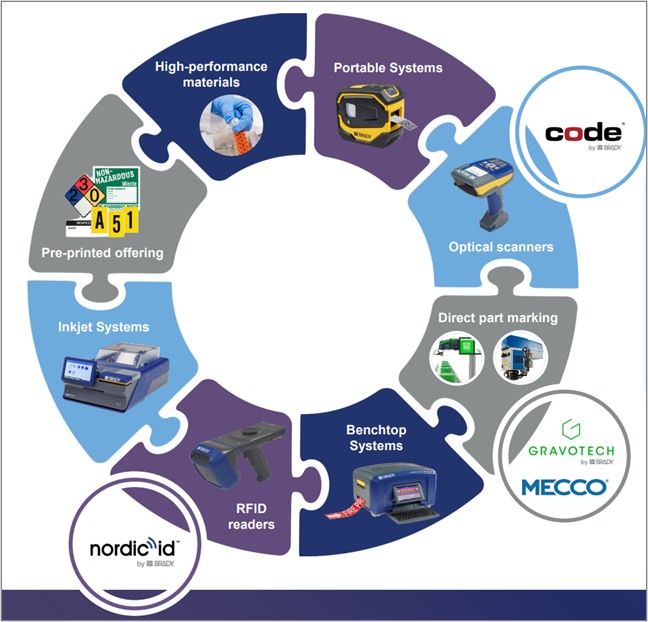
Source: November 2025 Brady Investor Presentation. All use of company logos, images or trademarks are for reference purposes only
The secret sauce… Brady makes the printers, the tracking scanners and software, the glue, the ink and of course the labels and nameplates itself, all in-house. The company spends tens of millions of dollars every year on research and development to improve its offering (think smart printing, smart tracking and new adhesives). This proprietary formula to create the best-in-class labels is protected by more than 375 patents. Gravotech’s laser technology is also protected by a suite of patents.
As a result, Brady occupies #1 or #2 market positions across all its industrial niches, and its global reach makes it a perfect cross-border partner to multinational customers. Rather than just a label-maker, Brady is the premier full-solution provider for its clients’ identification and tracking requirements. Having met with members of its European team at the Productronica 2025 trade fair in Munich, we learnt that Brady sales engineers will often incorporate new product ideas gleaned from interactions with customers directly into the R&D pipeline – an effective flywheel driving further customer success.
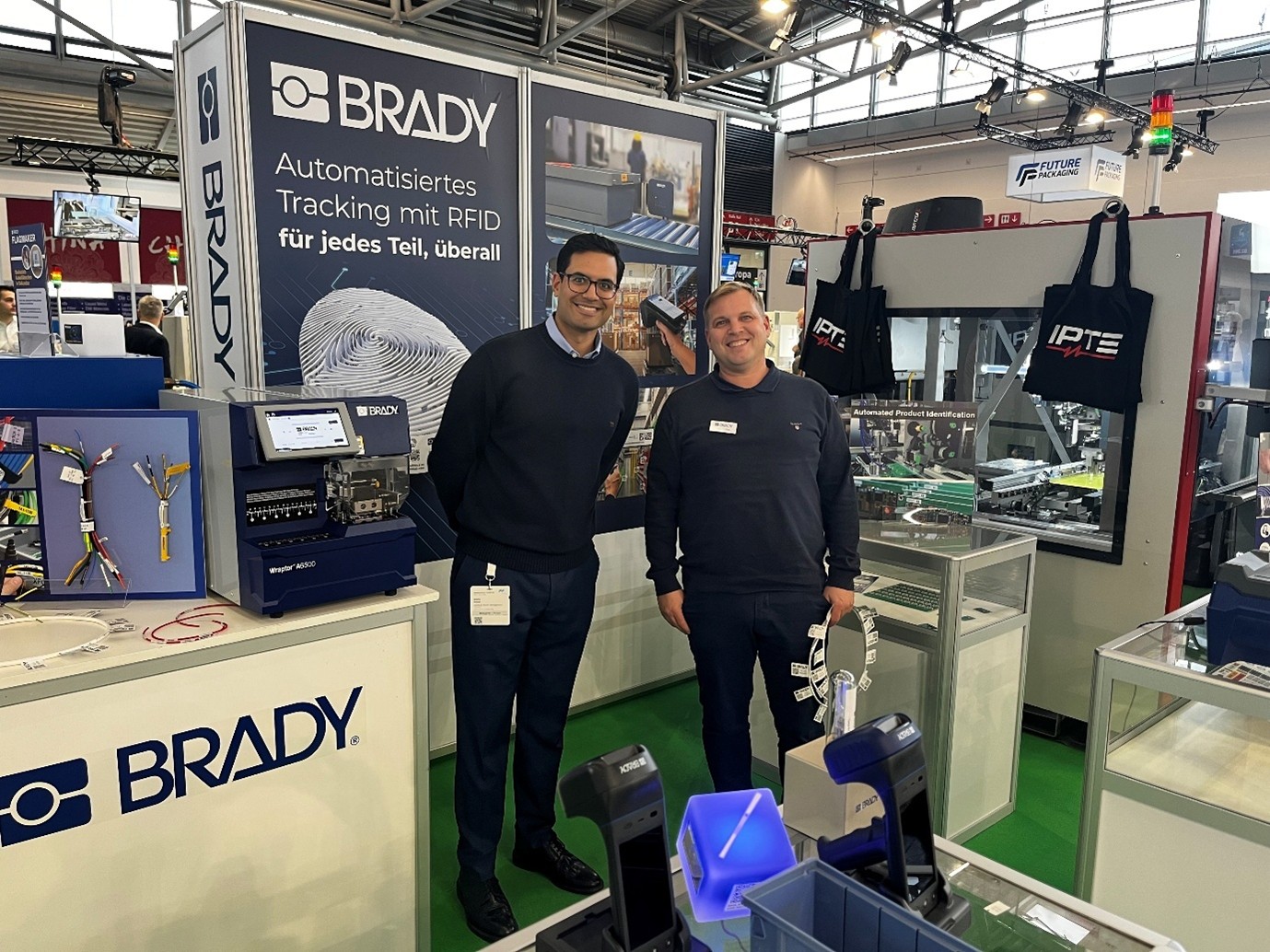
I met Sebastian Weiss of Brady at Productronica 2025 in Munich last month.
The business model is also resilient and cash generative. While Brady sells plenty of printers, scanners and other equipment, a large proportion of its revenue comes from re-occurring labels, ink and nameplate sales as customers refill, and these recurring sales come at higher margin. It is an effective razor/blades model that creates stability and visibility. Descendants of the Brady family still own a meaningful amount of the equity, making this a family-driven enterprise that focuses on quality and durability over the long term. The balance sheet is net cash and the company has not been free cash flow negative since 1992.
Brady has made smart and sensible acquisitions over time. For example, the company bought The Code Corporation in 2021 for its barcode and RFID-reading technology, and Gravotech in 2024 for its laser engraving capabilities. It also often bolts on small ink or printing businesses to enter new niches or capture and control more of the production value chain. These businesses often come with their own administrative functions, which are centralised within the larger Brady group to reduce operating costs and improve profit margins. Indeed, while Brady’s sales have grown at a relatively modest 4.2% compound annual growth rate (CAGR) over the past 10 years, consistent profit margin expansion has led to net income growing at a 13.8% CAGR over that period.
We see continued stable growth, opportunities for internal innovation and smart bolt-on acquisitions, ongoing margin expansion, sensible stock buybacks and a formidable market position enabling Brady to be a solid long-term compounder for our portfolio.
Brady has superior profitability and return on capital characteristics than the wider small cap universe, yet trades on a 2026 price-to-earnings multiple of 14.5x, compared to 18x for the Russell 2000, 23x for the S&P 500, or 17x for the MSCI ACWI Small Cap Index:
Brady Corp key metrics vs MSCI ACWI Small Cap Index

Source: Bloomberg. Data as of 31/10/2025.
Despite being a $3.7 billion market cap company, Brady is largely unknown to many investors. In our view, it is a true small cap hidden gem: niche market leadership, exceptionally strong financial returns and driven by a culture of long-term family ownership.
KEY RISKS
Past performance does not predict future returns. You may get back less than you originally invested.
We recommend this fund is held long term (minimum period of 5 years). We recommend that you hold this fund as part of a diversified portfolio of investments.
The Funds managed by the Economic Advantage team:
- May invest in smaller companies and may invest a small proportion (less than 10%) in unlisted securities. There may be liquidity constraints in these securities from time to time, i.e. in certain circumstances, a fund may not be able to sell a position for full value or at all in the short term. This may affect performance and could cause a fund to defer or suspend redemptions of its shares. May invest in companies listed on the Alternative Investment Market (AIM) which is primarily for emerging or smaller companies. The rules are less demanding than those of the official List of the London Stock Exchange and therefore companies listed on AIM may carry a greater risk than a company with a full listing.
- May encounter liquidity constraints from time to time. The spread between the price you buy and sell shares will reflect the less liquid nature of the underlying holdings.
- May invest in companies predominantly in a single country which maybe subject to greater political, social and economic risks which could result in greater volatility than investments in more broadly diversified funds.
- Outside of normal conditions, may hold higher levels of cash which may be deposited with several credit counterparties (e.g. international banks). A credit risk arises should one or more of these counterparties be unable to return the deposited cash.
The risks detailed above are reflective of the full range of Funds managed by the Economic Advantage team and not all of the risks listed are applicable to each individual Fund. For the risks associated with an individual Fund, please refer to its Key Investor Information Document (KIID)/PRIIP KID.
The issue of units/shares in Liontrust Funds may be subject to an initial charge, which will have an impact on the realisable value of the investment, particularly in the short term. Investments should always be considered as long term.
DISCLAIMER
This material is issued by Liontrust Investment Partners LLP (2 Savoy Court, London WC2R 0EZ), authorised and regulated in the UK by the Financial Conduct Authority (FRN 518552) to undertake regulated investment business.
It should not be construed as advice for investment in any product or security mentioned, an offer to buy or sell units/shares of Funds mentioned, or a solicitation to purchase securities in any company or investment product. Examples of stocks are provided for general information only to demonstrate our investment philosophy. The investment being promoted is for units in a fund, not directly in the underlying assets.
This information and analysis is believed to be accurate at the time of publication, but is subject to change without notice. Whilst care has been taken in compiling the content, no representation or warranty is given, whether express or implied, by Liontrust as to its accuracy or completeness, including for external sources (which may have been used) which have not been verified.
This is a marketing communication. Before making an investment, you should read the relevant Prospectus and the Key Investor Information Document (KIID) and/or PRIIP/KID, which provide full product details including investment charges and risks. These documents can be obtained, free of charge, from www.liontrust.com or direct from Liontrust. If you are not a professional investor please consult a regulated financial adviser regarding the suitability of such an investment for you and your personal circumstances.
