The attacks by the US and Israel on Iran that began in the early hours of Saturday morning, and the subsequent retaliation on multiple Middle East countries, has further ratcheted up both geopolitical tension and market uncertainty. We can expect this week to start with increased volatility, especially in energy markets, as well as across other investment markets.
It is important to remember, however, that at this stage we are dealing with markets repricing uncertainty rather than an economic shock and its consequences. As one observer has put it, “this is a period of elevated risk, not yet evidence of lasting economic damage”.
The key variable to watch is oil. Energy prices are the main channel through which geopolitical events can feed into inflation and impact growth and central bank policy. The important distinction is between a temporary geopolitical risk premium and a sustained physical disruption to supply. History shows that markets are very good at adjusting quickly once risks stabilise.
It is also worth placing current events in a broader context. While headlines focus on the risk of a “hot” conflict, the longer-term trend is towards a colder, more fragmented global environment. The world is becoming less synchronised, with old political alliances under strain or negotiation, and domestic politics have become polarised. This does not mean constant crises but it does mean markets are likely to remain more volatile than in the decade following the Global Financial Crisis.
Against this backdrop, our message to clients remains consistent:
First, diversification matters. Multi‑asset funds are portfolios are designed for periods like this. Genuine diversification across asset classes, sectors, regions and investment styles helps absorb shocks that originate outside the economic cycle, including geopolitical events and commodity price swings.
Second, discipline matters. Geopolitical events are emotionally powerful but they rarely change long‑term return paths unless they lead to sustained changes in inflation, earnings or growth. Reacting to headlines by making portfolio changes typically locks in losses rather than protects capital. As has often been said, “volatility is the price investors pay for long‑term returns”.
Third, differentiation matters. In a more fragmented world, outcomes are increasingly uneven across regions, sectors and asset classes. Active asset allocation, valuation awareness and flexibility across equities, fixed income and alternatives are essential in navigating this environment.
The approach of the Liontrust Multi-Asset investment team in recent years has adapted deliberately to a more complex world in which it is now impossible to rule out potential trends or events because they are seen as outside of what is rational or possible. This means broadening diversification, maintaining discipline through market stress and building portfolios that are differentiated. We believe this positioning remains appropriate given the current conflict in the Middle East.
This is also a reminder of the power of compounding. Long‑term wealth creation is driven not by avoiding every short‑term drawdown, but by staying invested through periods of uncertainty. Missing just a handful of strong recovery days can have a disproportionate impact on long‑term returns.
We continue to monitor developments closely, particularly energy markets and any signs the conflict could translate into sustained inflationary pressure or weaker growth.
As always, please do not hesitate to contact us if you would like to discuss this further or need support in client conversations.
KEY RISKS
Past performance does not predict future returns. You may get back less than you originally invested.
We recommend this fund is held long term (minimum period of 5 years). We recommend that you hold this fund as part of a diversified portfolio of investments.
The Funds and Model Portfolios managed by the Multi-Asset team may be exposed to the following risks:
- Credit Risk: There is a risk that an investment will fail to make required payments and this may reduce the income paid to the fund, or its capital value;
- Counterparty Risk: The insolvency of any institutions providing services such as safekeeping of assets or acting as counterparty to derivatives or other instruments, may expose the Fund to financial loss;
- Liquidity Risk: If underlying funds suspend or defer the payment of redemption proceeds, the Fund's ability to meet redemption requests may also be affected;
- Interest Rate Risk: Fluctuations in interest rates may affect the value of the Fund and your investment. Bonds are affected by changes in interest rates and their value and the income they generate can rise or fall as a result;
- Derivatives Risk: Some of the underlying funds may invest in derivatives, which can, in some circumstances, create wider fluctuations in their prices over time;
- Emerging Markets: The Fund may invest in less economically developed markets (emerging markets) which can involve greater risks than well developed economies;
- Currency Risk: The Fund invests in overseas markets and the value of the Fund may fall or rise as a result of changes in exchange rates;
- Index Tracking Risk: The performance of any passive funds used may not exactly track that of their Indices.
The risks detailed above are reflective of the full range of Funds managed by the Multi-Asset team and not all of the risks listed are applicable to each individual Fund. For the risks associated with an individual Fund, please refer to its Key Investor Information Document (KIID)/PRIIP KID.
The issue of units/shares in Liontrust Funds may be subject to an initial charge, which will have an impact on the realisable value of the investment, particularly in the short term. Investments should always be considered as long term.
DISCLAIMER
This material is issued by Liontrust Investment Partners LLP (2 Savoy Court, London WC2R 0EZ), authorised and regulated in the UK by the Financial Conduct Authority (FRN 518552) to undertake regulated investment business.
It should not be construed as advice for investment in any product or security mentioned, an offer to buy or sell units/shares of Funds mentioned, or a solicitation to purchase securities in any company or investment product. Examples of stocks are provided for general information only to demonstrate our investment philosophy. The investment being promoted is for units in a fund, not directly in the underlying assets.
This information and analysis is believed to be accurate at the time of publication, but is subject to change without notice. Whilst care has been taken in compiling the content, no representation or warranty is given, whether express or implied, by Liontrust as to its accuracy or completeness, including for external sources (which may have been used) which have not been verified.
This is a marketing communication. Before making an investment, you should read the relevant Prospectus and the Key Investor Information Document (KIID) and/or PRIIP/KID, which provide full product details including investment charges and risks. These documents can be obtained, free of charge, from www.liontrust.com or direct from Liontrust. If you are not a professional investor please consult a regulated financial adviser regarding the suitability of such an investment for you and your personal circumstances.

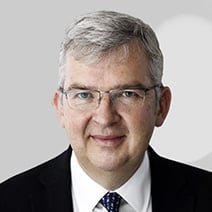
John Husselbee
John Husselbee is head of the Multi-Asset team at Liontrust. He is a fund manager and analyst with over 40 years’ experience managing multi-asset, multi-manager funds and portfolios. John leads the investment team, managing a range of target risk funds and portfolios as well as specialist managed investment solutions.
