This article is featured in the Q4 2025 Future Strategist newsletter, you can read the rest of the newsletter here.
In 2022, Meta’s shares fell 65%, underperforming indices by a significant amount. Over the last 10 years, Meta shares have only recorded a down year twice – 2018 being the other one. What did these two years have in common? In both cases, free cash flow (FCF) for the company, calculated as operating cash flows less fixed asset investment, fell. FCF fell by about 50% from $39.1 billion in 2021 to $19.3 billion in 2022. In 2018, shares declined 26%, with FCF falling 12%. FCF was set to decline in 2025 and to fall away more sharply in 2026 – which should be of concern.
OpenAI has become the poster child of optimism ever since it launched ChatGPT on the world in late 2022. At that time, the company was reported to have a market value of about $20 billion and minimal revenues. In just three years, revenues have accelerated from about $1 billion in 2023 to $13 billion in 2025, exiting the year at an annualised rate of $20 billion according to various press reports. At the same time, the company is reported to be trying to raise $100 billion of additional funding at a valuation of $830 billion. In just three years, the market has created a near $1 trillion company that has fast growing revenues but is losing an increasing amount of money year by year.
The Economist, using press sources and Pitchbook, estimates that OpenAI will lose about $10 billion in 2025, with losses increasing every year through 2029 before becoming profitable in 2030. The peak loss year will be 2028 at over $40 billion, and cumulative losses in the period will exceed $100 billion.
Both these examples represent investment opportunities in the biggest theme we have possibly ever seen – AI. It has been the biggest thematic driver for equities over the last two years – substantial amounts of freely available capital from the biggest companies in the world together with flows of abundant cash from many other sources have fuelled a faster growing fire of optimism about what AI will do for the world as well as the returns available for those companies that can harness it.
The problem is that fundamental investing is grounded in the value of the future cash flows a company can generate. Speculators and commentators have poured over the AI battlefield with views abounding but little in terms of a fundamental roadmap for valuation. We believe this changes in 2026.
Why did Meta fall so much in 2022? It was because cash flows dropped off sharply, thus changing the profile of expected returns and, more importantly, the timing of those returns. This matters. No one knows exactly how revenues will be generated from AI in the future or to which companies the cash flow and value will accrue – everyone has a view and it feels like a big game of Chinese Whispers. What we do know with certainty now is that the investment extravaganza is depressing current cash flows which is a red flag for valuation.
We believe those companies that compromise their cash flows for the nirvana of artificial general intelligence and future cash flow potential will be penalised. In simple terms, $100 earned in five years is worth only $60 today using a 10% discount rate. Giving up significant cash flow today to invest in an uncertain future must carry a valuation discount.
The table below highlights just how much is being invested in ‘the future’. It shows the biggest investors in AI infrastructure and the impact on cash flows and cash flow multiples that is having.
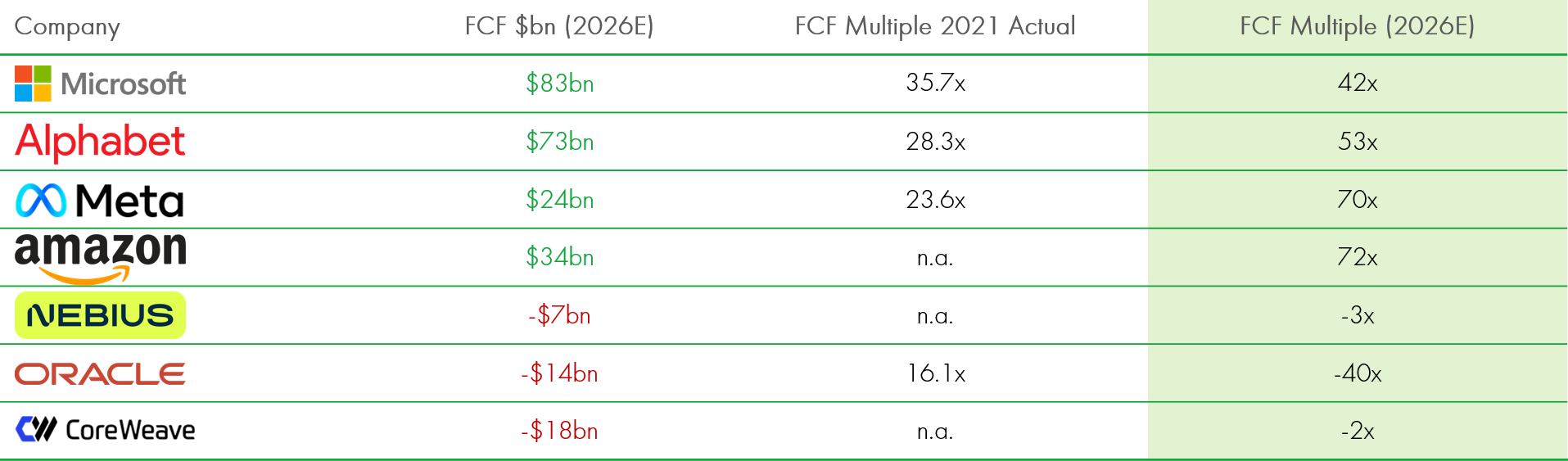
Source: Liontrust and Bloomberg, as at January 2026. FCF = Free Cash Flow defined as operating profit minus capital expenditure. Past performance does not predict future returns.
Most striking from this list is Oracle, which is investing so heavily in AI infrastructure that its market capitalisation to free cash flow ratio has moved from a healthy 16.1x in 2021 to negative 40x expected for next year. It has consistently generated strong cash flows for years but has chosen to compromise cash flow today for the hope of greater returns in the future. Why, as an investor, should I pay up for that?
Among mega caps, the multiples of free cash flow that investors are expected to pay is also rising steeply as capex spending accelerates. The biggest shift comes from Meta rising from 23.6x free cash flow in 2021 to a nosebleed 70x forecast for 2026.
We believe the sacrifice of cash flows today for the hope of more in the future will define 2026. Whatever the view on AI, an investor should pay less for the higher degree of uncertainty. For the first time, the market has a fundamental marker for valuation and this will likely lead to another year of significant polarisation of returns among the largest companies in the world and, quite possibly, a clear fundamental reason for them to lag the broader market too.
KEY RISKS
Past performance does not predict future returns. You may get back less than you originally invested.
We recommend this fund is held long term (minimum period of 5 years). We recommend that you hold this fund as part of a diversified portfolio of investments.
The Funds managed by the Global Equities Team:
- May hold overseas investments that may carry a higher currency risk. They are valued by reference to their local currency which may move up or down when compared to the currency of a Fund.
- May encounter liquidity constraints from time to time. The spread between the price you buy and sell shares will reflect the less liquid nature of the underlying holdings.
- May invest in smaller companies and may invest a small proportion (less than 10%) of the Fund in unlisted securities. There may be liquidity constraints in these securities from time to time, i.e. in certain circumstances, the fund may not be able to sell a position for full value or at all in the short term. This may affect performance and could cause the fund to defer or suspend redemptions of its shares.
- May have a concentrated portfolio, i.e. hold a limited number of investments or have significant sector or factor exposures. If one of these investments or sectors / factors fall in value this can have a greater impact on the Fund's value than if it held a larger number of investments across a more diversified portfolio.
- May invest in emerging markets which carries a higher risk than investment in more developed countries. This may result in higher volatility and larger drops in the value of a fund over the short term.
Certain countries have a higher risk of the imposition of financial and economic sanctions on them which may have a significant economic impact on any company operating, or based, in these countries and their ability to trade as normal. Any such sanctions may cause the value of the investments in the fund to fall significantly and may result in liquidity issues which could prevent the fund from meeting redemptions. - May invest in companies predominantly in a single country which maybe subject to greater political, social and economic risks which could result in greater volatility than investments in more broadly diversified funds.
- May hold Bonds. Bonds are affected by changes in interest rates and their value and the income they generate can rise or fall as a result; The creditworthiness of a bond issuer may also affect that bond's value. Bonds that produce a higher level of income usually also carry greater risk as such bond issuers may have difficulty in paying their debts. The value of a bond would be significantly affected if the issuer either refused to pay or was unable to pay.
- May, in certain circumstances, invest in derivatives but it is not intended that their use will materially affect volatility. Derivatives are used to protect against currencies, credit and interest rate moves or for investment purposes. The use of derivatives may create leverage or gearing resulting in potentially greater volatility or fluctuations in the net asset value of the Fund. A relatively small movement in the value of a derivative's underlying investment may have a larger impact, positive or negative, on the value of a fund than if the underlying investment was held instead.
The risks detailed above are reflective of the full range of Funds managed by the Global Equities Team and not all of the risks listed are applicable to each individual Fund. For the risks associated with an individual Fund, please refer to its Key Investor Information Document (KIID)/PRIIP KID."
The issue of units/shares in Liontrust Funds may be subject to an initial charge, which will have an impact on the realisable value of the investment, particularly in the short term. Investments should always be considered as long term.
DISCLAIMER
This material is issued by Liontrust Investment Partners LLP (2 Savoy Court, London WC2R 0EZ), authorised and regulated in the UK by the Financial Conduct Authority (FRN 518552) to undertake regulated investment business.
It should not be construed as advice for investment in any product or security mentioned, an offer to buy or sell units/shares of Funds mentioned, or a solicitation to purchase securities in any company or investment product. Examples of stocks are provided for general information only to demonstrate our investment philosophy. The investment being promoted is for units in a fund, not directly in the underlying assets.
This information and analysis is believed to be accurate at the time of publication, but is subject to change without notice. Whilst care has been taken in compiling the content, no representation or warranty is given, whether express or implied, by Liontrust as to its accuracy or completeness, including for external sources (which may have been used) which have not been verified.
This is a marketing communication. Before making an investment, you should read the relevant Prospectus and the Key Investor Information Document (KIID) and/or PRIIP/KID, which provide full product details including investment charges and risks. These documents can be obtained, free of charge, from www.liontrust.com or direct from Liontrust. If you are not a professional investor please consult a regulated financial adviser regarding the suitability of such an investment for you and your personal circumstances.

Mark Hawtin
Mark Hawtin is head of the Global Equities team. Mark joined Liontrust in 2024 from GAM, where he was an Investment Director running global long-only and long/short funds investing in the disruptive growth & technology sectors. Before joining GAM in 2008 he was a partner and portfolio manager with Marshall Wace Asset Management for eight years, managing one of Europe’s largest technology, media and telecoms hedge funds.
